SKYORB ∞ is now available on PC through the Windows Store and Google Play.
Version 1.5 is also out for iOS and macOS, with many bug fixes, improved planet rendering, and a better imported-orbits chart display.
The SkyORB 2021 is now SkyORB Classic and updates are now returning : iOS 26, update interface and ‘travel’ simulation added. We have also updated the Windows Store version with DX12 and new improved engine!
SkyORB Classic now returns to App Store and resuming support !
We’re excited to announce new updates for both SkyORB 2021 (LTS 13) and SkyORB ∞ (1.3.4), bringing a refreshed experience and some powerful new features—exclusive to iOS devices this summer 2025!
A Redesigned Search Experience in SkyORB 2021
With version 2021 LTS 13, we’ve completely redesigned the search page using modern UI elements for a cleaner, more intuitive experience. Whether you’re looking for planets, stars, comets, or satellites, the updated interface makes it faster and easier to navigate.
Introducing Home Screen Widgets
Widgets are now officially supported in both SkyORB 2021 and SkyORB ∞, giving you at-a-glance access to astronomical information—right from your Home Screen.
In SkyORB 2021, we’ve brought back the beloved Astronomy News widget (iOS 15+), perfect for staying updated on upcoming celestial events.
In SkyORB ∞, we’ve added two new widgets (iOS 16+): – A Sky Chart Widget showing a preview of the visible sky from your location. – A Lunar Calendar Widget that tracks the current moon phase and upcoming lunar cycles.
Plus, Bug Fixes and Performance Improvements
As always, these updates include various performance optimizations and bug fixes to keep your experience running smoothly.
Welcome to SkyORB Beta: Explore the Universe with Enhanced Features
Prepare to embark on an extraordinary cosmic journey with the SkyORB Beta version. As we gear up for our grand launch, we invite you to be among the first to experience the marvels of the universe like never before.
In this brief guide, we’ll walk you through the key features of the SkyORB Beta version. From immersive 3D star maps to real-time celestial tracking and precise solar and lunar insights, you’re in for an astronomical treat. We’ve also got you covered with a celestial event schedule and comprehensive planet details.
Let’s dive into the wonders of the universe with SkyORB Beta!
The Main Page
Welcome to the main page of SkyORB beta. To get started, click or tap the box displaying your current location’s name. You’ll be directed to the observation page.
Beneath this, you’ll find two icons on the left side. The first icon will lead you to the notification page, while the second icon with three lines grants access to the Explore Universe page.
Image 2: The Observation Page
The observation page is where you’ll find essential information based on your current location. Scroll down to explore additional details like scheduled events, today’s celestial highlights, sun charts, sun-related information, and much more.
For a full-screen view of the sky chart, simply tap the ‘Current Sky’ bar.
Image 3: Current Sky Settings
This section allows you to customize your sky-viewing experience. You can choose to enter full-screen mode and switch between manual and ‘compass’ orientation.
There are three projection modes available, with the classic Altazimuth mode being particularly helpful for stargazers who want to ‘point to the sky’ and identify stars and planets.
Image 4: Explore Universe
The Explore Universe section provides access to a range of cosmic wonders. By default, you’ll see a list of planets and the solar system. To change your options, simply tap on ‘Solar System’ for additional choices or select a specific planet. Each planet has its dedicated page.
Image 5: Explore Universe – Viewing Options
Exploring the universe is a breeze with SkyORB. Tapping ‘Viewing’ reveals various viewing modes. Take your pick from options like planets, dwarf planets, galaxies, nebulae, constellations, stars, asteroids, comets, and many more celestial views.
Feel free to explore and make the most of SkyORB’s beta version. Happy stargazing!
If you want to participate to the Test Flight version, which has limited seat, please use the contact page on this site.
Je vais m’exprimer en français ici, car c’est important. L’une des fonctionnalités de SkyORB ∞ est de proposer une application entièrement en français. C’était une lacune dans la version SkyORB 2021, qui proposait des langues comme l’anglais, le français, l’espagnol, l’indonésien, l’italien, le coréen, le portugais, le russe, le chinois et le néerlandais.
Le problème était que certaines choses, comme les “nouvelles d’astronomie”, n’étaient pas traduites. La version Apple Watch était partiellement traduite, et la fonction de “génération” de texte, une autre grande fonctionnalité de SkyORB, avait de nombreuses fautes et ne fonctionnait vraiment qu’en anglais.
De plus, des informations telles que les noms des nébuleuses et des étoiles n’étaient pas toujours correctement traduites.
Dans SkyORB Infinite, le système de base de données de texte a été entièrement repensé, et l’IA générative de texte pour les prévisions a été retravaillée pour gérer la conjugaison et la grammaire. Ainsi, seules le français et l’anglais seront disponibles au début, les autres langues suivront ultérieurement.
La version 2021 propose désormais les “nouvelles d’astronomie” en deux langues : français ou anglais par défaut.
Oui, SkyORB est conçu par des Français depuis 2002. L’idée était de créer un planétarium, une carte du ciel et des éphémérides précises. Dans SkyORB ∞, l’accent est principalement mis sur les éphémérides, les notifications et la facilité d’explication des événements astronomiques, d’où l’importance d’une bonne traduction.
Je tiens également à souligner que SkyORB ∞a été soumis à l’Apple Store pour le programme Test Flight (ce 6 Octobre 2023) . Dans les prochains jours, les premiers testeurs nous feront part de leurs retours sur cette nouvelle version.
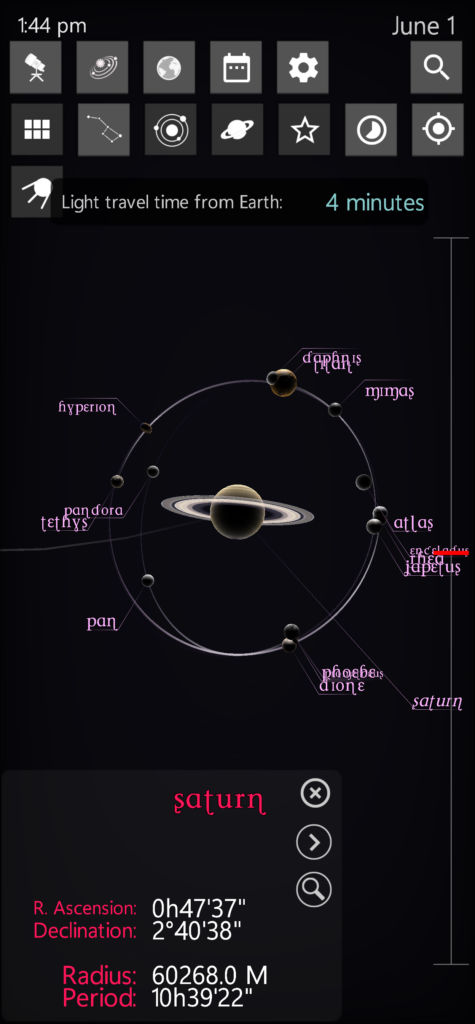
As we embarked on the journey of developing SkyORB, our mission was clear: to enhance the user experience of this powerful astronomy engine. In doing so, we not only gave the interface a complete makeover but also undertook a meticulous review of some of the longstanding features. For instance, Pluto, once considered a planet, was reclassified as a dwarf planet. The demarcation between celestial bodies like moons and planets is now crystal clear in the new version. We also addressed numerous typographical errors, including the distinction between Japetus and Iapetus.
One significant enhancement we made was in the realm of local sky projections. We introduced three distinct projection modes: the altazimuth, now significantly refined, the default stereographic projection, and the gnomonic projection, which proves invaluable when observing objects directly overhead.
For telescope enthusiasts, we incorporated a feature that provides a view akin to peering through a telescope. This mode is not limited to the moon; it also works wonders for planets like Jupiter and its moons, as well as Saturn. What sets it apart is the precision of moon positions, accounting for the time light takes to travel, sometimes resulting in up to a 20-minute delay and occasionally presenting distinct observations.
Our rigorous testing took us outdoors, to real locations and various latitudes, to ensure the accuracy of our calculations. Notably, our “point to sky” function is now ever-ready, with options neatly tucked into a full-screen menu for convenience.
We’ve optimized SkyORB Infinite for urban stargazing, recognizing that city lights may dim the number of visible stars. Rest assured, SkyORB will prioritize showing you the celestial wonders that matter most in these settings.
The moon, with its ever-shifting angle of tilt, is now portrayed accurately. This is especially crucial for stargazers in the southern hemisphere or those at latitudes in the tropics where lunar angles play a pivotal role.
In SkyORB 2021, we utilized 3D rendering, but in SkyORB Infinite, we’ve transitioned to the superior 2D projection. This not only enhances accuracy but also ensures consistent rendering across all platforms. Any discrepancies, including those from SkyORB 2021, have been diligently addressed.
In summary, SkyORB Infinite represents a significant improvement in helping you identify celestial objects with its enhanced “point to sky” feature. The new notification system, featuring daily, monthly, and lunar events, is now thoughtfully separated, making it exceptionally handy for planning your next star-gazing adventure.